Wednesday, May 29, 2013

Pricing integrity - How I can always get you the best price

I have had many a member contact me upset and in a flurry about how they saw an item in a store that we carry in the showroom, but; there was either no savings or extremely minimum savings. The member than feel that they have been mislead and how can this be as DirectBuy should always have the better price.
 
Well on the last point they are right, we should have the better price and this is where the price integrity comes in.

Price Integrity

 
Sometimes manufacturers think they can be sneaky and offer deals to their retailers, this is where members who shop in the retail community come in. Although we tell you not to shop stores, you are still our eyes and ears in the retail community and one of our ways of keeping manufacturers honest.
 
If ( and when) you find a product that you know we carry ( it is an apples to apples comparison) and you notice that the price is really good and there is little to no savings .
 
LET US KNOW!!
 
We will take all your information, what the model # and manufacturer is and where you saw this product ( online, flier and in store pricing  is OK, Craig's list and EBay not acceptable)
 
Any of the service staff will submit this info to our corporate office, they will than contact the store to verify the item. If they find that this is a legit pricing situation, ( it is not discontinued product or a loss leader sale - stores offer select items at or below cost for a limited time frame to attract customers in order to sell them other products) than the manufacturer will offer a concession price.
 
Here is an  example,
 
 
A member was looking at a camera, the price in the centre was $800.00 + 4% handling, $12.00 freight and 12% taxes, a total of $945.25
 
At a camera shop in the city, they were selling the same unit for $820.00 after taxes $918.40
 
Our cost was $26.85 more than the retail store.
 
I submitted a price integrity, once all the information was confirmed the manufacturer came back with an offer of $600.00 to the member to purchase the camera through us. They knocked off an additional $200.00!!!
 
 
There are many more situations that I could go into but I do not want to bore you, lol.
 
So when shopping for products, if you notice that there is little to know savings for an item ( or items) LET US KNOW and we will do all we can to either get you a better price or explain the reason behind ( again usually a discontinued product or loss leader sale) the lack of savings .
 
If you have any questions feel free to comment or email me at the centre


Thursday, May 9, 2013

Window Treatments

 
So this topic is a little bit of a doozy and usually boggles many a mind. I hope this post will help to clarify "window treatments" for some. So where to start...
 

How do I measure?

Well you have two options,
 
1) the centre can put you in touch with an installer who will also do the measurements or
2) you can measure yourself
 
here is how it works.


Inside mount

You should measure all three widths of the window, top, middle and base. This is in case the window is not the same width all the way down and will help avoid the window treatment scraping the casing in areas that are more narrow . You will order the smallest of the three measurements
 
FYI, manufacturers will take off deductions on inside mount measurements ("tight" measurements) unless we specify not to. I do not recommend ordering exact for inside as something always goes wrong.
An installer will measure inside mount blinds with deductions in mind.
Deductions are usually and 1/8" of an inch off of each side, so a total of 1/4" usually

Please measure to the 8th as if you measure to the 16th I will just have to convert back to 8ths.
 

Outside Mount

 
Depending on what you want to cover will determine your measurements, whether you want to only cover the glass and leave the casing visible or cover the total casing.
 
Also, when measuring take into account if you are not mounting onto casing that you need to know the head rail height so you can add this to your overall height.
 
No deductions will be taken from outside mount blinds


Bay Windows
 
You will have to first identify the depth of your head rail . it is vital with bay windows
as the blinds meet in the corners of the bay and they should not overlap or touch for
 perfect operation of the blinds.
 
Square Bay
There are three options as below:
 
For option A you will measure tight corner to corner and then deduct the size of the
head rail from each of the side blinds and select inside recess option.
For the drop will be ceiling to window sill/floor or from where you would like the
 blind to hang from to where you would like it to finish and always select inside recess option.
 
For option B you will measure tight corner to corner and then deduct the size of the
head rail from each side of the front blind measurement and select inside recess option.
For the drop will be ceiling to window sill/floor or from where you would like the blind
 to hang from to where you would like it to finish and always select inside recess option.
 
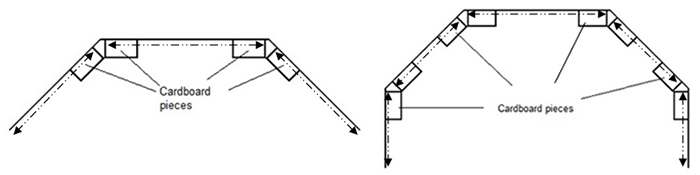
For option C you will take two pieces of cardboard cut at the size of the head rail and meet
 them head to head in the corner of your bay as in the picture above and then mark on the
 window frame where the cardboard touches the frame. Select inside option for recess.
 
NOTE: Please make sure the cardboard pieces touch when measuring.
 
For the drop will be ceiling to window sill/floor or from where you would like the blind to
hang from to where you would like it to finish and always select inside recess option.
 
Any other bay
 
You will have to measure each window using a piece of cardboard cut square at the size
of the head rail and following the diagram below.
NOTE: Please make sure the cardboard pieces touch when measuring.
 
 
Cardboard pieces cut at the size of the head rail
Once you have decided where each blind will sit you will mark on your window frame
and measure between the markings. Always give us the measurements as inside recess.
 
For the drop will be ceiling to window sill/floor or from where you would like the blind
to hang from to where you would like it to finish and always select inside recess option.


Budget?

  • Depending on your budget may determine the window treatments you choose

What is the application?

  • The type of treatment you choose will usually be determined by the application,
 
here are some suggestions.


Bedrooms where you do not want any light

 Cellular/Honeycomb Shade

 
  •  Cellular/Honeycomb shades. Not only will you get the tightest fit in the window and the least amount of "halo" light  but they are also very clean and simple in looks.
 
  • Cellular/Honeycomb shades also have the most features available. You can do top down, bottom up
 
  • Cordless
  • Top down, bottom up cordless
  • veriglide (only one or two suppliers do this)
dual shade ( duo lite, day/night) - This is usually a sheer or semi-opaque (light filtering) window treatment on top and a semi-opaque ( light filtering) or opaque ( room darkening) treatment on the bottom. Keep in mind this version you will be paying for two window treatments in one window


Faux and Real Wood


  • Another option for bedrooms that is more reasonable is the real or faux wood blinds. These can look lovely depending on the colour and application. For bedrooms most manufacturers now have an option of "no router holes" for their wood blinds. This means, there will be no holes in the slats that the strings run through. Instead the slats will sit on what is termed "ladders". The slats do move more but they will close tighter and not let light through.
  • This is also a great option instead of doing the tapes to cover the holes ( they look like suspenders)
 
 No Router Holes

With router holes


  • FYI - Wood blinds stack really thick so if you are wanting to be able to clear most of your window for a great view, these would not be the window treatments for you. Wood blinds are meant to be tilted more than lifted
  •  
  • Most manufacturers will also offer their tilt option as either a wand or a cord
  • This (for most) is not an up charge.
 

Pleated shades


  • Pleated shades are nice if you want a similar look to a cellular/honeycomb but less cost. I find that they are pretty but not as substantial as a cellular as they are just one piece of fabric, plus you will have router holes as this is the only way to hang them and you can not cover them up 
Options :
  • Cordless
  • Top Down Bottom Up
  •  
 

Metal Venetians

 
  • Metal blinds will essential have the same options as a wood blind when it comes to function, the only different is  you will always have router holes on a metal blind.
  • There is also the sound that they will make when touched, however metal blinds have come a long way when it comes to colour and texture. There are companies that will make these window treatments with wood valances and even finished wood trim
  • These window treatments are very inexpensive and are great for areas where they may get dirty or wet like, the bathroom, garage, kitchen, laundry room and so forth.


Roller Shades

Roller shades have come along way from the 70's PVC look that hung in your grandma's bathroom. You know have many tactile options,
  • Fabric
  • PVC
  • PVC Sunscreen
  • woven wood
  •  
  • I will usually suggest roller shades in kitchens and bathrooms as they are usually ( if you go with the PVC material) much easier to clean than most.
 
     
  • The sunscreens are great for sun rooms or rooms that have alot of heat caused by sun exposure. You can go from a 1% ( only 1% of light is allowed through) all the way up to a 14%. This application is great for windows where you would still like to see out during the day but have UV protection and privacy.
This is an example of a screen weave.
 
 
  • If you want privacy in the evenings once the sun goes down I would not recommend a screen weave. All of a sudden you can not see out, but everyone who looks in can see in your home.
 
  • Some manufacturers offer a dual shade roller system which can alleviate this problem as you can get a translucent or sheer weave fabric and also a black out for privacy


example of a dual roller shade


  • The one downside to roller shades is that no matter how tight you get your measurement, you will always loose around 1/2" on either side as the fabric is on a roll and this caused the blind to start further in.
 
 
See the gap?
 
 
Not great for bedrooms where complete room darkening is required.


    You could avoid this by doing an outside mount so the fabric covers the opening completely


Most companies will offer what they call a "black out" system for their rollers which is channels that are installed into the casing and the shade runs through the track so there is no light

 
example of a track system


Valances

 
  • Although I really like the open roll look as it is very clean and modern some still enjoy the finished look of a valance. Here are some options for the top of your blind


Open roll
 
 
Fabric Valance
 
 
 Cassette Valance


Pocket valance


Panel Track


  • Panel track is somewhat of a new concept for a vertical. What is great is most fabrics that are for the roller shade programs are also available in panel track which can make coordinating window treatments very easy.

  • The only issue is the panels are usually 20" wide so if you do not have the space to stack the blinds off the window you will need to decide if you are still interested in this treatment.
  • It is the same as verticals, they will always have a certain width of stack that will ether cover the window ( or the patio door) unless you mount them and order them to be larger than the window treatment

FYI they also make awesome room dividers!!


Multiple blinds on one head rail.

  • Sometimes you will run into windows that are to wide or tall for a single blind. In these cases you may have the option of a multiple blind on one head rail option
  • what this option allows for it 2 things
1) you will have less of a gap between the blinds than if they were mounted separately
2) you will have one continuous head rail instead of separate head rails


There are quite a few suppliers that do their own unique window treatments that I would be more than happy to show you in our showroom.
 
Just and FYI : To order blinds you must make an appointment as it takes around 5 to 15 minutes to order each blind.
 
 
I really hope this post helps, and if there are any questions please do not hesitate to post in comments : D

Tuesday, March 5, 2013

One of these Stainless Steel appliances is not like the other, one of these Stainless Steel appliances just doesn' t belong

 
  • Many will know this but not all. When you buy stainless steel appliances from different manuafacturers (and even the same sometimes) be prepared that they will not match exactly.
  •  
     
  • Each company sources material from different suppliers so it would stand to reason that not all material will be the same including the steel.
  •  
  • But, did you know that ordering within the same manufacturer you may not get the same steel?
  •  
  • If a manufacturer has different "series" of appliances you will find that not only the logo and handles will be different but so will the steel.
  •  
     
  • This is something to keep in mind, expecially if you are going for a matching space
 

Saturday, August 18, 2012

Manitoba Hydro Power Smart

Sooo, for all those whom are not aware, you can apply ( in the centre) for a Manitoba Hydro Power Smart Loan. The loan covers the following upgrades:

Loan Details

  • Borrow up to $7,500 per residence. Up to $5,500 of that may be put toward the purchase of a high efficiency natural gas furnace.
  • The maximum term is 5 years for all energy efficiency upgrades and 15 years for the purchase of a high efficiency natural gas furnace.
  • Annual interest rate is fixed at 3.9 per cent (O.A.C.) for the first 5 years.
  • Monthly installments will be included on your energy bill.
  • Applicant must be a Manitoba Hydro customer and the owner of the home in which energy improvements are to take place. ( for at least 1 year)
  • Upgrades must be made to levels recommended by Manitoba Hydro. NOT ALL WINDOWS WILL MEET THE STANDARDS FOR A HYDRO LOAN
  • The loan does not apply to central air conditioning (see The Energy Finance Plan (EFP)).

Here is some info and tips on how to go about applying with very little hick ups

In the centre we will help you to fill out the loan application, below is the info that we will need to submit the application

The quote and or pricing for all product and labour


Credit Information  such as - Anual Income (for both home owners if applicable)
                                               Loans and other obligations
                                               Name of Home Insurance company, amount of insurance
                                              Manitoba Hydro account #

We will than submit the paper work, once the loan is approved, you will than come back into the centre to place the order. When the job is complete ( to your satisfaction) you will than come back into the centre to sign the finalizing paper work that will allow Manitoba Hydro  to release the funds for your loan to the centre


If you have any other questions, please either contact the centre or comment on this post and I will reply back

Ceramic Tile wear and tear 101

The Porcelain Enamel Institute (PEI) has a scale that was created to determine the resistance of an enameled surface in relation to the traffic and wear the surface will endure. Once assigned a rating, tiles can be evaluated to better determine which tile to use for a given application. The PEI Rating of ceramic tile is one factor to help determine it's appropriateness in a project.

The Porcelain Enamel Institute was founded in 1930 and has three primary objectives aimed at advancing porcelain enameling manufacturers and suppliers thereof:

  1. To promote manufacturer's new products and their process improvements to manufacturing operations.

  2. To provide general promotion of porcelain products.

  3. To advance and protect the porcelain industry.

PEI achieves these objectives through representation from all segments of the porcelain industry, who work together to offer various programs and services to industry executives.
The PEI Scale, or PEI Rating, is a vital tool when deciding which tile is best for you because it classifies the ceramic surface in terms of how much wear the tile can bear without damaging its appearance.

CLASS 0 - Tiles technically unsuitable for floors.
CLASS 1 - Residential and commercial wall and bare foot traffic.
CLASS 2 - Wall and residential bath floor, and soft soled traffic.
CLASS 3 - All residential floors and light commercial floors.
CLASS 4 - Medium commercial, light industrial and institutional, moderate soiling.
CLASS 5 - Extra heavy traffic, abrasive dirt, chemically more resistant.


While it is true that the higher the PEI rating, the greater the resistance of the enamel, the PEI floor rating is not the only factor that should be evaluated when choosing a tile.
  Other factors to consider when choosing porcelain tile include:

  • shape and dimension

  • visual inspection

  • coefficient of friction (how easily an object moves across the surface of the tile); water absorption

  • bond strength

  • breaking strength

  • abrasive hardness, chemical resistance

  • crazing (resistance to cracking)

  • freeze/thaw resistance

  • impact resistance

  • MOHS scale scratch test (how easily the tile scratches)

  • acid resistance

  • water penetration through glaze

  • cleanability

  • marking resistance to metals

Of these factors, the three considered the most important are the PEI rating, the water absorption, and the glaze hardness (MOHS scratch test).

In addition to these structural characteristics, the tile's aesthetic qualities are very important to consider. Ask yourself if the edges are square or warped, is the surface texture consistent, are the tiles are the same size and is the coloring consistent. High quality tiling translates to a high quality floor. The grout lines will be uniform, the colors will be consistent, the floor will have a consistent height, your project will go much faster, and you'll be more satisfied with your new floor.
Largely due to the Porcelain Enamel Institute, ceramic floors are becoming more popular with consumers today. The PEI has helped to improve the strength and durability of tile, as well as the design, color, and other visual aspects of tile. With the assistance of the Institute and the PEI scale, look for continued improvements by the tile manufacturers and continued expansion in tile selection for consumers.

Flooring( in general )101

The different types of flooring we sell at DirectBuy are

Hardwood
Laminate
Tile -Ceramic, Porcelain, Quarry, Saltillo, Mosaic, Terracotta Stone
       - Granite, Marble, Limestone and Slate
Carpeting
Bamboo
Cork
Vinyl
Linoleum

Each type of flooring is different and has pros and cons about it durability and cost effectiveness. I will be providing you with a general description of what each type of flooring.

Wood – Solid wood or engineered planks.

Pros
– Beautiful, warm, soft on the feet, fairly durable, long-lasting if properly sealed and
maintained, can be refinished, many wood types and hues to choose from, can be painted or
stained for more color options, helps tie kitchen to other rooms in an open floor plan. Although
hardwood can initially cost more than some other flooring options, it's an investment that pays
off, increasing the value of your home.
Cons
– Susceptible to water damage, darkens with age, expensive to very expensive, softer
woods can dent easily, harder to keep clean than vinyl or laminate – water and spills need to be
cleaned immediately. Dust everywhere with refinishing or new installation of unsealed wood.
Tip - Material must acclimate for 48 hours before installation.
Stone – Granite, Marble, Limestone, Slate
Pros
– Beautiful and durable, with many color and pattern choices. Nearly indestructible.
Tumbled or honed finishes give good traction. Granite is the strongest.
Cons
– Cold and hard on the feet. Very expensive. Slate is more affordable, but can be rough
and can peel. Glossy finishes are slippery when wet and must be polished regularly. Tumbled or
honed stone must be sealed regularly. Stone is heavy and may need a stronger subfloor. Marble
will be damaged by chlorine and can absorb dirt. Limestone and Slate collect dirt.

Tile – Ceramic, Porcelain, Quarry, Terra Cotta
Pros
– Huge selection of mixable colors, shapes, sizes and patterns. Durable if well made.
Glazed tiles are moisture and stain-resistant. Most are easy to maintain. Mosaic tile can be laid
on uneven surfaces. Can be very affordable. Easy for do-it-yourselfers.
Cons
– Cold and hard on the feet. Can be very expensive depending upon what you choose. Can
crack or chip and is difficult to repair. Glossy finishes are slippery when wet. Grout can discolor
and is hard to maintain.


Laminate – Imitation Wood, Tile or Stone
Pros
– Durable, easy to maintain, scratch-resistant, wide range of colors and designs, can be
installed over old flooring, can be affordable, quiet when used with underlayment, good choice
for damp areas and below grade, easy installation – good choice for do-it-yourselfers, has
color/grain uniformity, many click together styles require no glue.
Cons
– Cannot be refinished if damaged. Some can be expensive – as much as wood.
Tip - Material must acclimate for 48 hours before installation.


Vinyl Flooring
Pros
– Inexpensive, durable, easy on the feet, quiet, water and stain resistant, and low
maintenance. It's easy to install – especially tiles. 12-foot wide sheets mean seamless floors in
small rooms. You can create patterns with tiles.

Cons
– Prone to dents and tears. Moisture can get into seams leading to mildew and lifting.
Glossy finishes are slippery when wet, and can dull easily unless waxed regularly.

Carpet
Pros
– Warm, easy on the feet, quiet, lots of colors and styles to choose from, choice of wall to
wall or area rugs, slip-resistant, can be affordable.

Cons
– More appropriate for drier climates. Collects dirt and moisture – which can turn into
mildew. Wall to wall carpeting is not a good choice for people with dust allergies. It's hard to
clean. Polypropylene or washable area rugs best choice.

Cork
Pros
– Cork is soft and warm, wide array of colors and patterns, great texture, easy to install,
can be affordable. Option of unfinished or polyurethane-sealed.

Cons
– Must be sealed. Not as durable or easy to clean as vinyl. May not be a good choice for
"rough" families.

Linoleum
(Made from linseed oil, wood flour and/or cork dust and sometimes
pine rosin, jute and limestone.)

Pros
– Comes in wide range of colors, quiet, durable, biodegradable, environmentally friendly,
hygienic and anti-static.
Modern linoleum doesn't wear down like the old type from the '50's. The glue is better, so it
shouldn't pucker up over time.

Cons
- Porous, it may need to be waxed or polished from time to time. Strong overall, but
difficult to repair if there is a problem.

Bamboo Flooring
Pros
- Environmentally friendly & renewable, durable, hard and stable.
Cons
- Renewability - The first being bamboos rapid renewability has some manufacturers harvesting it
before it is mature therefore not producing quality, hard floor planks. Flooring that is made before the
bamboo is at least 4 years old is soft and may easily warp and dent, Low quality production and
warranty - make sure you take a look at the manufacturer's warranties. A quality manufacturer will likely
warranty their bamboo flooring for at least 10 years structurally and 25 years on pre-finishing.

Thursday, July 5, 2012

Deadbolts, Levers and Knobs 101

It seems more often than not I have members standing in front of me, holding a lock set manufacturers catalogue with a lost and confused look on their face. Now, this blog may not help you to understand the catalogue 100% but it may help you to understand the different terms and basics of ordering lock sets, etc.

When ordering handsets for your front and/or back door, you must not only choose the exterior handle set but you must also choose the interior lever or knob when placing orders. They are priced separate in all catalogue price lists but must be ordered as one singular line item
Double cylinder deadbolts


will not pass fire inspection in Canada, so if you are building or renovating and will need to pass an inspection, you will not. Because of the key being needed for both sides, a double cylinder can be a hazard if there was a fire.
Single cylinder is the way to go!!


When choosing interior levers always remember, if it has a lock on it you will need to determine the handing ( this is also needed with entry sets). If it is a knob this is not necessary. Easy rule of thumb whatever side the hinges are on is the handing

Left Hinge =  Left handing  
Right Hinge = Right handing   


Keyed alike - Pretty much all our suppliers will key all the locks alike if requested when the order is placed and will even key to existing locks if you are willing to send a key in with the order!!


A mortise lock is one that requires a pocket—the mortise—to be cut into the door or piece of furniture into which the lock is to be fitted. They are widely used on all ages of domestic properties in Europe.
Although the installation of a mortise lock actually weakens the structure of the typical timber door, it is stronger and more versatile than a bored cylindrical lock, both in external trim, and functionality.

File:Mortise-lock.jpg


A bored cylindrical lock is one in which two holes are bored, perpendicular to one another, into the door. A large hole is bored into the door face and a smaller cross bore hole is bored into the door edge, as opposed to a mortise lock prep cut into the edge of the door. Typically, the face hole is sized from 1.5 inches to 2.125 inches (3.8 to 5.4 cm) and is centered at 2.375 inches or 2.75 inches (6.0 cm or 7.0 cm) from the leading edge of the door, this distance is referred to as the back set. Other, less popular, back sets are at 3.75 and 5 inches (9.5 and 12.7 cm). Residential doors are normally prepared for a 2.375 inch (6.0 cm) back set and commercial doors at a 2.75 inch (7 cm) back set..


BACK SET

Back set is the distance from center edge of door to center of the

2-1/8" (54mm) diameter hole, 2-3/8" or 2-3/4" in most cases